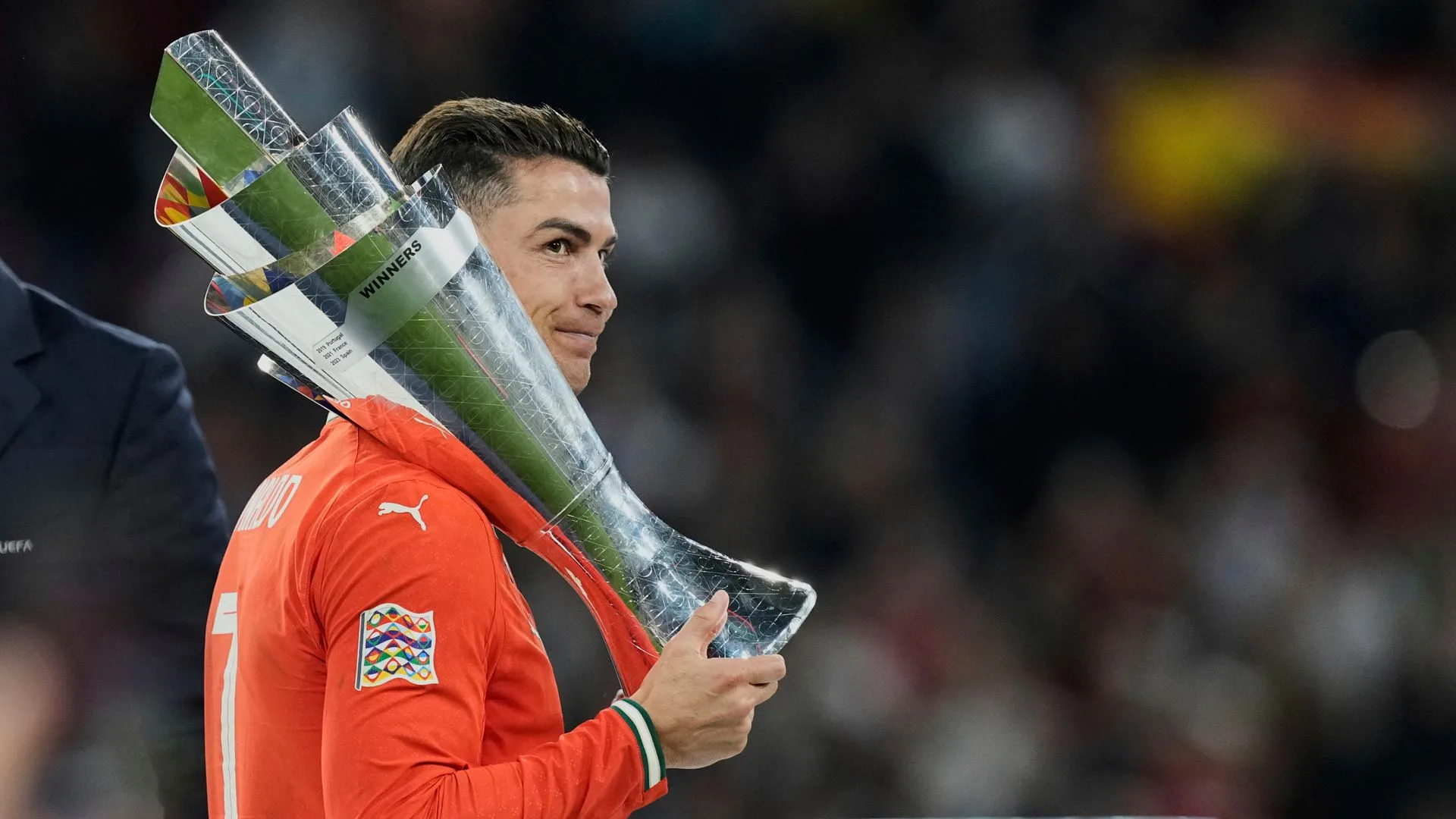
Cristiano Ronaldo has officially retired from international football, concluding a 23-year career with Portugal that saw him earn 234 caps and score 146 goals. The 41-year-old forward steps away from the national team following a significant falling out with head coach Jorge Jesus during the most recent international break. His departure marks the end of an era defined by record-breaking statistics, major tournament triumphs, and intense public debate regarding his legacy.
Ronaldo’s tenure with the Seleção is widely regarded as the most successful period in the country’s football history. He was instrumental in securing the Euro 2016 title, Portugal’s only major tournament victory, alongside two UEFA Nations League championships. Although injury forced him to watch the majority of the 2016 final from the sidelines, he remained a central figure in the nation’s celebration, coaching and cajoling his teammates with his leg strapped.
The former Manchester United and Real Madrid star also delivered a decisive performance in the 2014 World Cup play-off against Sweden. In an epic showdown against Zlatan Ibrahimovic, Ronaldo hit a hat-trick in the second leg to secure Portugal’s place in Russia, overcoming Ibrahimovic’s two goals. He reflected on that pivotal moment, stating: “I know Portugal needed me in these matches and I showed that I am here.
His consistency across six World Cups and six European Championships cemented his status as a global icon. Ronaldo initially matched Pauleta’s Portugal scoring record of 47 goals in 2014 before subsequently obliterating it to reach a final tally of 146. In his official retirement statement, he reflected on his lifelong ambition, saying: “I spent my life working to become the best player in the world.
He added: “Today, I realise that my greatest victory was earning the honour of representing the best country in the world. These sentiments come from a man who captained Portugal 172 times, demonstrating a profound emotional connection to the national jersey. His allegiance to the country was famously highlighted during the 2006 World Cup, where his wink to Portugal supporters after a red card incident with Wayne Rooney underscored his priorities.
The intensity of his focus meant that international defeats often felt more personal than club losses. The image of him breaking down as he exited the 2022 World Cup through the tunnel cruelly captured the pain of falling short on the biggest stage. He acknowledged these struggles in his statement, conceding: “There were also moments when I couldn’t give the Portuguese people what they so desperately wanted.
He further admitted: “Defeats that still hurt to remember. The early warning of the challenges ahead came in his first tournament, Euro 2004, where Portugal suffered a shock loss to Greece in the final on home soil. Despite his prolific club scoring form, replicating that success in crucial international moments proved difficult for the veteran striker.
Ronaldo scored just once in four separate World Cups, with his first and only World Cup knockout goal arriving this summer via a penalty against Croatia. This narrative of unfulfilled potential was often contrasted with that of his great rival, Lionel Messi, who faced similar criticism during the majority of his Argentina career. However, Messi’s recent triumphs, including the 2022 World Cup win and two Copa America titles, effectively dismantled that critical narrative.
In contrast, Ronaldo’s international career concluded with him an unused substitute in Norway, following a summer where his presence in the starting XI was viewed by some as detrimental to the team. At the age of 41, he was unable to justify the tactical system still being set up to serve his individual needs. The shift in dynamics was evident when Goncalo Ramos scored the winner against Croatia in injury-time, after Ronaldo had been substituted off.
Ramos had previously scored a hat-trick in a 6-1 demolition of Switzerland at the last World Cup, a match where Ronaldo had fallen out with coach Fernando Santos and been dropped for the last-16 tie. Ramos was present again to score the winner in Norway, while Ronaldo warmed up on the bench, bristling about what he described as broken promises.
The tension culminated in a breach of trust with Portugal boss Jorge Jesus, leading Ronaldo to leave the camp early in an ugly exit. His subsequent reveal of eight points he wanted Jesus to address in an apologetic press conference highlighted the self-confidence and focus that had propelled him to the top of the game. In that statement, he referenced himself as “someone of the stature of Pele or Maradona,” reflecting the arrogance that defined his peak years.
This self-centred focus meant he would never slip into the role of a squad player, a dynamic that complicated his final international chapters. Given his enormous profile, his presence at this summer’s World Cup seemed essential to the football industry. A red-card ban he had received against the Republic of Ireland was helpfully cancelled by FIFA, allowing Ronaldo to feature from the first whistle in North America.
Portugal’s exit to Spain in the last-16 was an anti-climax, capping a tournament that highlighted the changing tides in international football. Ronaldo has now blown the final whistle on his international career himself, leaving behind a legacy that is both extraordinary and deeply divisive. The Portuguese FA, which issued only the mildest of punishments for his September outburst and walkout, have promised a big send-off for the record holder.
The debates about his achievements and legacy will continue for years, focusing on whether he should have lifted the team to greater heights in his pomp. Ultimately, his 23 years of passionate service to the nation have etched his name into football history, regardless of the final chapter’s contentious nature.
Reporting and fact-checking compiled by The National Wales newsroom desk. Dedicated to verified public-interest journalism across Cymru.

Eli Nathan
Editor-in-Chief & PublisherCovering national Welsh affairs, Senedd politics, regional developments, and cultural life for The National Wales.
Learn about our editorial standards →