
Senedd clash over M4 relief road and third Menai crossing
Transport Minister Mark Hooper and Reform MS Louise Emery spar over funding, timelines and strategy for a new Menai bridge and the controversial M4 relief road.
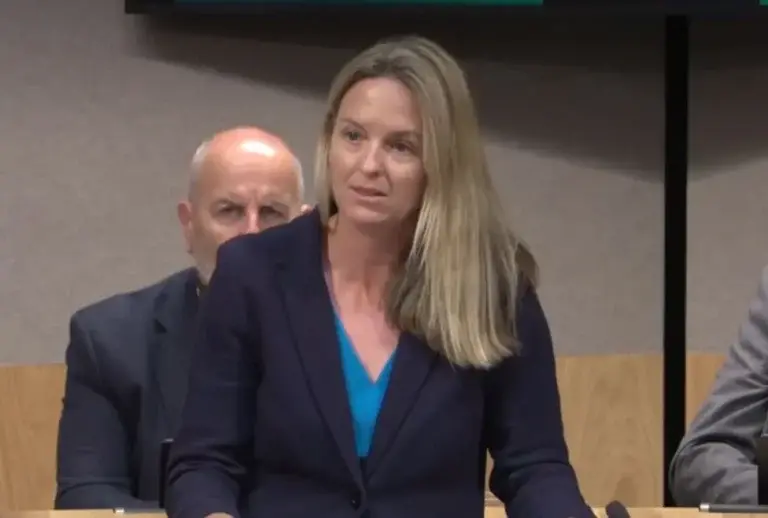
A heated exchange erupted in the Senedd on Tuesday as Transport Minister Mark Hooper faced fierce criticism from Clwyd MS Louise Emery over the future of the third Menai crossing and the long‑promised M4 relief road.
Emery, speaking for the Reform group, opened the debate by urging the minister to “stop thinking and just get on with it”, a plea that set a confrontational tone for the session.
She then questioned the lack of detailed funding in the minister’s statement, accusing him of “just thinking about a third bridge, which simply is not good enough”.
Hooper replied that his government remained fully committed to delivering the new Menai bridge, dismissing the criticism as a misunderstanding of the construction process.
“The member, and all of this [Reform] group around here, just seem to think that you can click a finger and things happen,” he said, adding, “Let’s get into the real world.” The real world is that it takes real work to get these things done.”
He went on to note his anticipation of the debate, saying, “The interesting thing is, when I was speaking to civil servants earlier prior to this, I was saying I was looking forward to this debate, because I do look forward to these debates.” Do you know what they were saying?
They’re looking forward to getting stuck into doing the work. That’s what they’re waiting for, and that’s what’s going to happen.”
Emery shifted focus to the M4, demanding a long‑term solution for the congested corridor around Newport.
Hooper acknowledged the M4 as “one of the most important transport corridors in Wales” and outlined an 18‑month programme to develop engineering solutions, followed by a five‑year delivery plan targeting road and junction improvements.
He warned that the plan could involve temporary local closures, describing the approach as a strategic suite of projects rather than a single “silver bullet”.
Emery dismissed the measures as a “sticking‑plaster approach” linked to an anti‑motorist agenda, and called for the reinstatement of the cancelled “black route” relief road.
She cited Reform UK’s costing of the project at £2.8 billion, stating, “Yes, that’s a lot of money, but I will guarantee here that, if there is a Reform Welsh Government, we will be lobbying and working with a Reform UK Westminster government – which is coming, ladies and gentlemen – and we will build the M4 relief road.”
Hooper countered that reviving the black route would take decades before construction could even begin.
“To suggest to the people outside that you can deliver it in an instant is disingenuous – and I’m being kind in saying that,” he warned.
He reaffirmed the government’s commitment to “making an actual difference to people”, insisting that the M4’s challenges required a coordinated set of interventions.
“This is about a strategic suite of projects that need to be deployed together.” These are the ways that we make the difference to the M4.
And it’s not straightforward. There is no silver bullet.
If there was, we’d talk about it,” the minister concluded.
The debate highlighted a stark divide between Reform’s push for a costly new relief road and the Welsh Government’s emphasis on incremental engineering solutions, leaving the future of both the Menai crossing and the M4 corridor uncertain.