
Pembrokeshire council may drop plan to strip Ysgol Cilgerran’s faith status
Council officers recommend abandoning the proposal to change Ysgol Cilgerran’s voluntary‑controlled status amid legal concerns and strong community opposition.
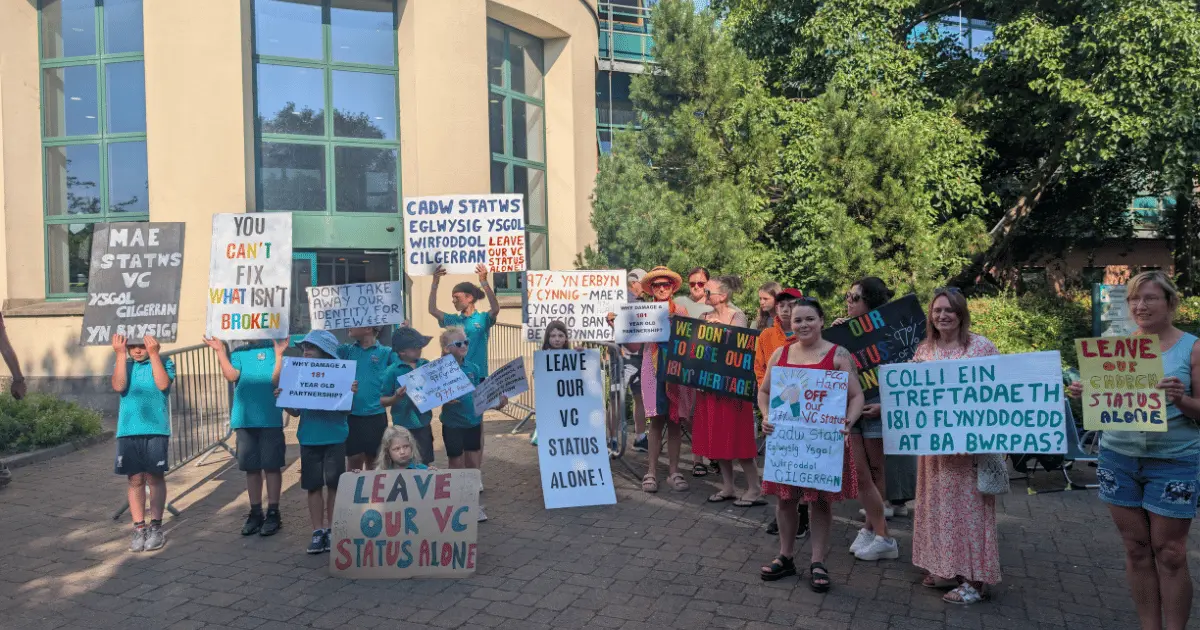
Pembrokeshire County Council is poised to abandon a proposal to remove the Church in Wales voluntary‑controlled status from Welsh‑medium Ysgol Cilgerran after a statutory report highlighted serious legal risks.
The council’s own officers concluded that ending the school’s current status could create “a material risk that continuity of education at the existing site could not be assured during or following implementation”.
In May, councillors voted to discontinue the voluntary‑controlled arrangement and re‑establish the institution as a 3‑11 community school, despite a consultation that recorded 197 objections to 3 supporters out of 203 responses.
Local opposition was fierce. A petition on the council’s website amassed 391 signatures, and hundreds of parents, teachers and pupils marched to County Hall in Haverfordwest for the July meeting, brandishing handmade signs that read “You can’t fix what isn’t broken”, “Leave our VC status alone” and “Don’t take away our identity for a few £££”.
The Church in Wales lodged a formal objection, warning of legal action and accusing council officers of “public misrepresentation and unqualified legal assertions” and “discrimination against faith schooling”.
Legal experts note that the school’s land is held in trust for the Church of Wales, meaning any change would effectively create a new school without premises to occupy.
Wales Humanists and the National Secular Society have voiced support for the council’s original plan, arguing that a secular community school would better reflect the declining pupil numbers and surplus places identified in a prior review.
Even the Roman Catholic Church in Wales urged the council to abandon the scheme, joining the broader faith community in its criticism of the proposal.
In June the council issued a statutory notice, attracting 91 formal objections that will be tabled at the October 15 meeting when councillors will decide the fate of the plan.
The forthcoming report recommends dropping the proposal, citing “separate and potentially complex property and occupation issues” and questioning the council’s ability to discontinue the existing school while continuing to occupy the site for a newly established community school.
It adds that exposing pupils, parents or staff to the “degree of uncertainty” surrounding the transition would be inappropriate, especially given the council’s intention to keep education on the same site.
Council leaders retain the option to proceed, amend the scheme or abandon it entirely, but the weight of legal advice and community opposition appears to be steering the decision towards withdrawal.
Should the council drop the plan, Ysgol Cilgerran would retain its voluntary‑controlled status, preserving its historic link to the Church of Wales and maintaining the current governance structure.
Any reversal, however, would likely prompt renewed debate over the future of faith‑based education in a region where pupil numbers are falling and school capacity is under review.
The final vote on 15 October will determine whether the school’s religious character endures or gives way to a secular community model, a decision that could set a precedent for other faith schools across Wales.