
Paul Davies praises Pembrokeshire volunteers rescuing shearwaters
Senedd member lauds local volunteers who saved over 1,100 Manx shearwaters in 2025, urging greater light‑pollution controls.
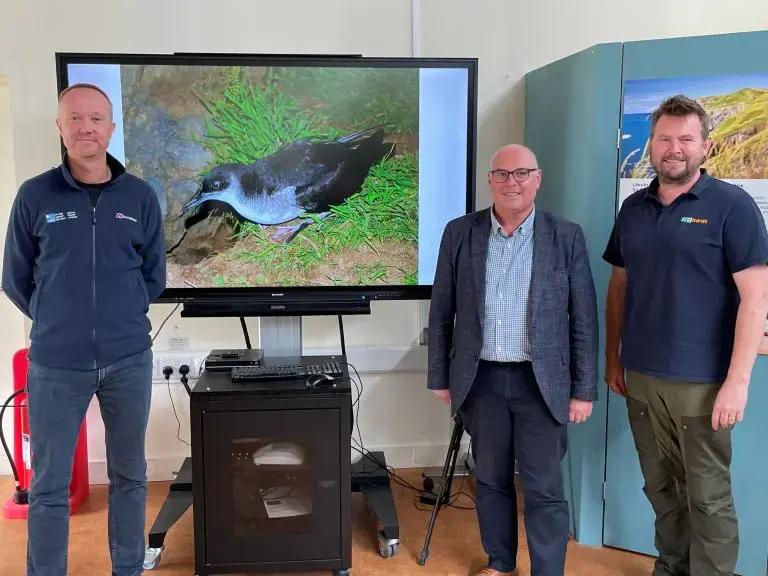
Conservative Senedd Member Paul Davies praised the volunteers who rescue fledgling Manx shearwaters across Pembrokeshire after meeting RSPB representatives in St Davids on Friday.
Davies, who represents Ceredigion Penfro, took on the role of Manx Shearwater Species Champion at Oriel y Parc, accompanied by Greg Morgan, the RSPB’s Ramsey Island reserve site manager, and Jeremy Wadia, a volunteer with Manx Shearwater Rescue Pembrokeshire.
The islands of Skomer, Skokholm and Ramsey host more than half the world’s breeding population of the seabird, making the county a crucial stronghold for the species.
Manx shearwaters nest in burrows before embarking on a trans‑Atlantic migration that carries them to the waters off South America for the winter.
Young birds set out after dark, but artificial illumination from buildings, roads and vessels can disorient them, pulling them inland.
Grounded chicks become vulnerable to traffic, predators and the elements, prompting volunteers to locate and return them to sea.
RSPB Cymru reports that volunteers rescued and released more than 1,100 Manx shearwaters in Pembrokeshire during 2025, including birds affected by storms and light pollution.
“To think that around half of the world’s breeding Manx shearwaters nest on our islands, before travelling thousands of miles across the Atlantic, is quite extraordinary,” Davies said.
He singled out the work of volunteers around Newgale, noting that without their help many fledglings would never reach the ocean.
“Without their intervention, many of these birds might never make it safely out to sea,” he added.
Davies stressed that his new champion role will focus on collaborating with the RSPB and local conservation groups to raise awareness of the threats facing the birds.
“We are incredibly fortunate to have such important wildlife on our doorstep, but that also brings a responsibility to protect it,” he said.
Previous appeals have urged coastal residents to close curtains and switch off unnecessary external lights during the fledging season.
Drivers have also been asked to remain vigilant for grounded birds along roads near the coast.
The rescue network has identified Newgale, Broad Haven, the Milford Haven Waterway and Tenby as hotspots where fledglings frequently become stranded.
Members of the public who find a shearwater are directed to contact Manx Shearwater Rescue Pembrokeshire on 01437 723193 for guidance.
Volunteers operate a coordinated system that records each rescue, assesses the bird’s condition and arranges a safe release at sea, often within hours of discovery.
Greg Morgan highlighted the importance of community involvement, noting that the sheer number of birds rescued would be impossible without local support.
He added that the RSPB continues to monitor breeding success on the islands, using the data to inform conservation strategies.
Jeremy Wadia, who has been part of the rescue effort for several years, described the work as “a labour of love” that relies on swift action and careful handling.
He explained that volunteers carry the birds in soft cloth bags, keep them warm and release them at dusk when the birds are most likely to navigate successfully.
The partnership between volunteers, the RSPB and the Senedd aims to reduce the impact of artificial lighting and improve public understanding of the species’ life cycle.
Local councils have begun reviewing street‑light policies, exploring options such as shielding and dimming during the critical fledging period.
Conservationists also advocate for the use of bird‑friendly lighting on vessels operating near the islands, to minimise disorientation.
Davies’ endorsement of the volunteers underscores the growing political recognition of wildlife protection as a community priority.
He indicated that future initiatives may include educational programmes in schools and targeted outreach to holiday‑makers in the area.
The ongoing rescue effort demonstrates how coordinated grassroots action can safeguard a species that traverses half the globe each year.
With the breeding season now underway, volunteers remain on alert, ready to intervene whenever a fledgling is drawn ashore by stray light.
As the Atlantic migration looms, the hope is that continued awareness and protective measures will allow more shearwaters to complete their epic journey.