
Volunteers hailed for protecting Manx Shearwaters in Pembrokeshire
The meeting highlighted the crucial role of community volunteers in safeguarding one of the county’s most remarkable seabirds.
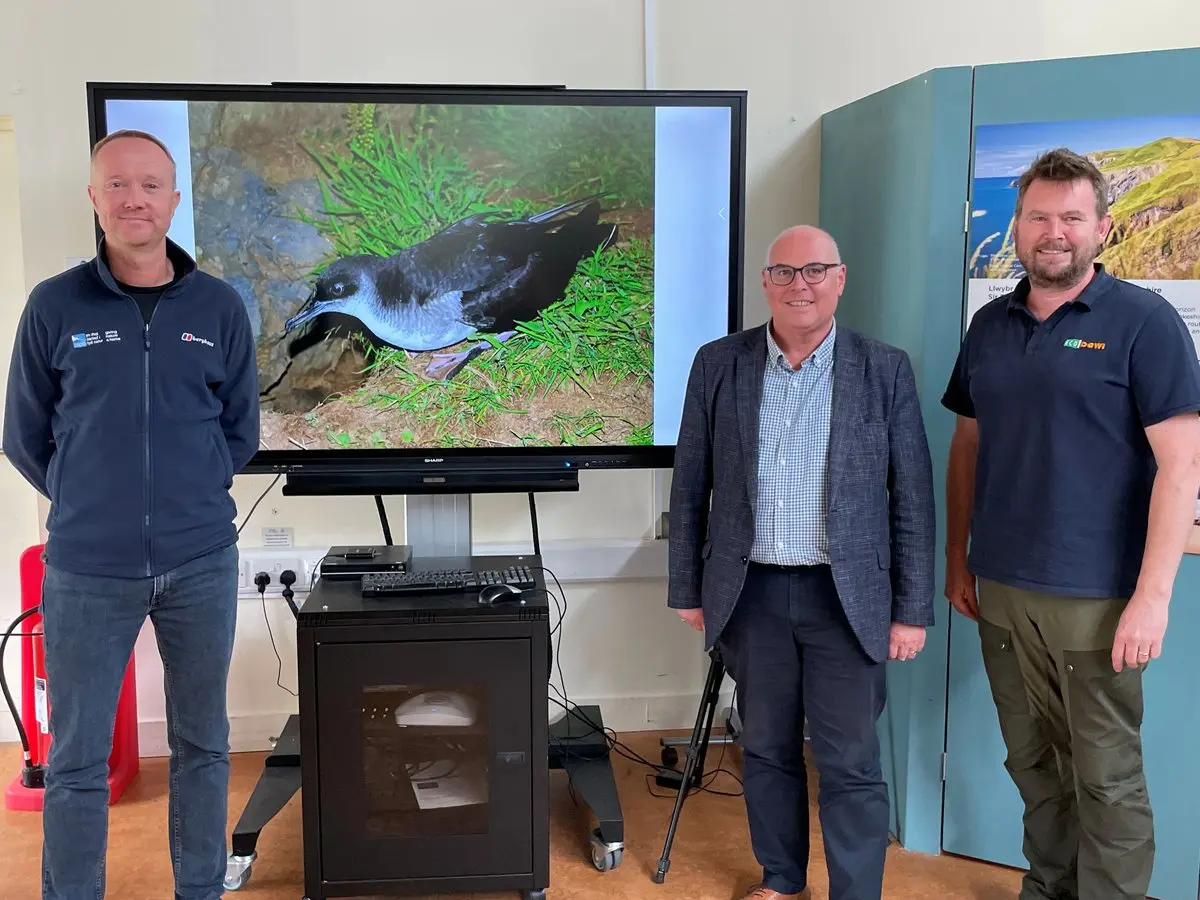
Volunteers rescuing disoriented Manx Shearwaters in Pembrokeshire have been lauded after Senedd member Paul Davies met RSPB representatives at Oriel y Parc in St Davids.
The meeting highlighted the crucial role of community volunteers in safeguarding one of the county’s most remarkable seabirds.
Manx Shearwaters breed on Pembrokeshire’s offshore islands, which support roughly half of the global breeding population.
Each year the birds embark on a trans‑Atlantic migration, wintering off South America before returning to Welsh cliffs in spring.
Young birds face a perilous first flight, often becoming confused by artificial lights on land and roads.
When disoriented, they can land on pavements, become exhausted and fail to reach the sea.
A volunteer group known as Manx Shearwater Rescue operates around Newgale, locating, caring for and releasing these fledglings.
Greg Morgan, site manager for the Ramsey Island Reserve, explained that timely intervention can mean the difference between life and death for the birds.
Jeremy Wadia, a long‑standing volunteer, described the routine of night‑time patrols, checking coastal paths and road verges for stranded chicks.
“Until you learn more about these incredible birds, it’s difficult to appreciate just how special they are and how important Pembrokeshire is to their survival.”
To think that around half of the world’s breeding Manx shearwaters nest on our islands, before travelling thousands of miles across the Atlantic, is quite extraordinary.
What really struck me during the meeting was the dedication of local volunteers, particularly those working around Newgale, who give up their own time to rescue young birds that have become confused by artificial lighting.
Without their intervention, many of these birds might never make it safely out to sea.
We are incredibly fortunate to have such important wildlife on our doorstep, but that also brings a responsibility to protect it.
I’m delighted to have become a Manx Shearwater Species Champion and look forward to working with the RSPB and local conservation groups to raise awareness of the challenges these birds face and the practical steps we can take to help them.
I also want to say a huge thank you to everyone involved in the rescue work. Their commitment is making a real difference,” he added.
Mr Davies, newly appointed Species Champion, said the encounter reinforced his belief that community action is essential for the birds’ survival.
He pledged to promote awareness of artificial lighting impacts and to support measures that reduce night‑time illumination near nesting sites.
The RSPB confirmed that ongoing monitoring of breeding colonies will continue alongside volunteer‑led rescue efforts.
Data collected by volunteers assists scientists in understanding fledgling mortality rates and the effectiveness of mitigation strategies.
In a related cultural initiative, Dr Julian Ruddock of Aberystwyth University’s School of Art is translating his research on the shearwaters into a multidisciplinary artwork.
His project, which blends film, sound, installation, drawings and paintings, will feature at Oriel y Parc in May 2027.
Dr Ruddock’s fieldwork included visits to Skomer, Skokholm and Ynys Enlli, where he documented the birds’ behaviour and the islands’ habitats.
The forthcoming exhibition aims to raise public appreciation for the species and the conservation challenges they face.
Local authorities have also been urged to review street‑lighting schemes near key nesting cliffs to minimise future disorientation incidents.
Conservation groups stress that while legislative measures are important, the hands‑on work of volunteers remains the frontline defence for fledgling shearwaters.
As the breeding season progresses, the demand for rescue volunteers is expected to rise, with calls for more community members to join the effort.
Stakeholders agree that protecting the Manx Shearwater not only preserves a unique part of Wales’ natural heritage but also contributes to global biodiversity.
Continued collaboration between the RSPB, local volunteers and government representatives is set to underpin the species’ long‑term survival.