

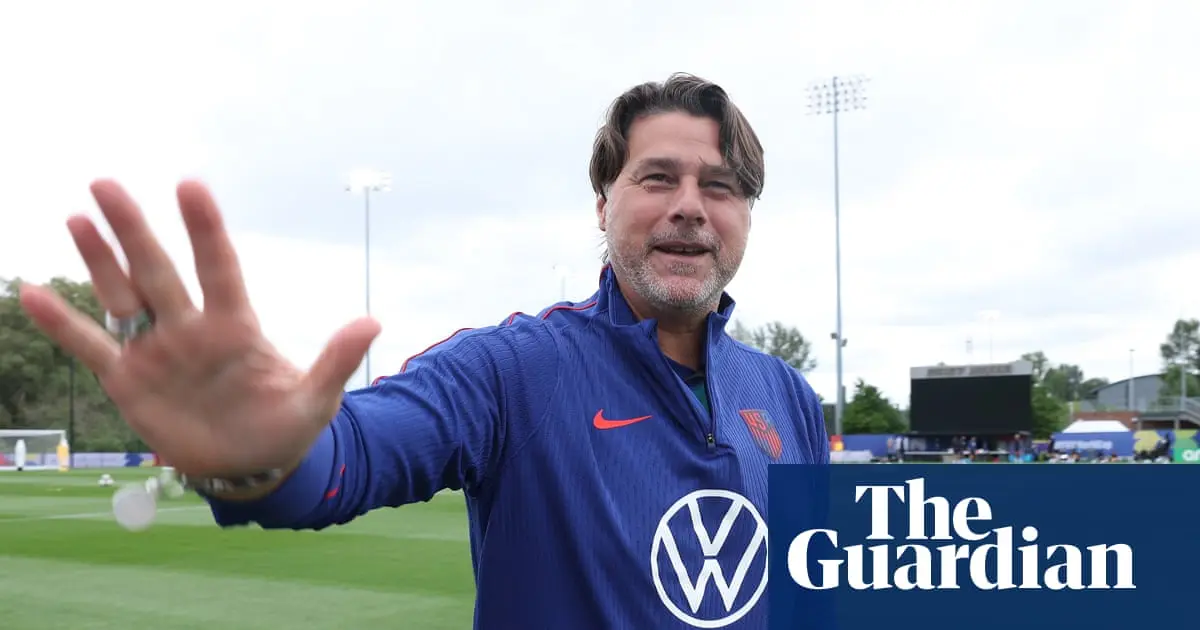
Mauricio Pochettino’s potential move to Manchester United represents a significant disruption for the United States men’s national team, which he guided to the last 16 at this year’s World Cup. The former Tottenham Hotspur manager is widely regarded as a prime candidate for the Old Trafford vacancy, creating immediate tension with his current role as US head coach.
As Pochettino departed the podium to conclude his final press conference of the international window, he offered an ambiguous farewell to the media. “See you next …” Pochettino began as he headed towards the tunnels of Allianz Field in Saint Paul, before cutting his sentence short.
He then delivered a sing-song remark: “See you next, see you next.” The incomplete phrase left room for interpretation, though it was not necessary to use artificial intelligence to guess the intended conclusion. “See you next month” would have been synonymous with “see you next window,” given the cyclical nature of international football.
The poignant nature of the farewell reflected widespread questions regarding whether Pochettino would remain in the role for a full four-year cycle. In hindsight, he may have omitted a clause indicating his departure for a new project. From the moment Pochettino and US Soccer announced his contract renewal in August, many doubted he would wear his distinctive safari shirts on the US sideline at the 2030 World Cup.
Pochettino is a name brand in club management, with a résumé characterised by unfinished business. Few elite coaches consider themselves satisfied with merely finishing as Premier League and Champions League runners-up. The era of clubs with major financial considerations pulling the plug on a whim has passed, making the current timing crucial for potential suitors.
The start of an international window is the ideal time for a new manager to meet the squad and implement an initial scheme to stabilise the team. This places international federations like US Soccer in an unenviable position, as Pochettino remains among the most eligible options for major European clubs. His continuing presence on managerial wishlists ensures that the most likely window for advances from club suitors coincides with the period when a national team coach works hardest.
In September, this meant reviving years-old discourses about the apparent irresistibility of Tottenham Hotspur. Before the World Cup, AC Milan had also come calling for his services. Now, the focus turns sharply to Old Trafford, where the attraction of Pochettino’s profile is logical and compelling for the board.
For over a decade, Manchester United have tested every managerial archetype possible since Sir Alex Ferguson called time on his illustrious career. They have appointed domestic options who punched above their weight class, chronic winners, and onetime supernovas with implosion all but inevitable. They have also relied on club legends, custodians, and young options ready for a Premier League closeup.
Their tenures all ended the same way, leaving the club in search of a definitive solution. Pochettino blends some of the best traits of Louis van Gaal and José Mourinho with a record of doing the work United hoped would happen under Ruben Amorim and Michael Carrick. His work building Tottenham into a threat on all fronts bolstered his culture-building cachet, showing his success at Espanyol and Southampton could scale.
Even though his time at Paris Saint-Germain failed to yield their long-coveted Champions League title, he had experienced managing the egos of Neymar, Kylian Mbappé, and Lionel Messi. Chelsea tested his tolerance for ownership-meddling, providing further evidence of his resilience. All of these factors inform Manchester United at present, making him a highly attractive prospect for the Red Devils.
So, the idea of Pochettino leaving the US so soon into his second term is hardly a shock. If it was not to be United, or Tottenham, he would remain a hot commodity if Real Madrid were to quickly abandon their reunion with Mourinho. If not them, then perhaps Milan again if their campaign were to sour before the festive season.
US Soccer deserves some credit for adequately preparing for this potential departure. For one thing, Pochettino’s retention was only made possible thanks to a billionaire super-donor, Ken Griffin. So while his wages dwarfed those of his predecessors, it had not directly come at the expense of the federation’s other teams, initiatives, or grassroots efforts.
The real boon is his release clause, a reported $10m (£7.5m) option that only a Big Club could afford to spring. Had Pochettino left after the World Cup, coach and federation would have parted with nothing more exchanged than a handshake and some pleasantries. Instead, they forged an insurance policy to make up for what could have been if Pochettino had stayed for a full cycle.
Of course, piles of money don’t qualify for World Cups. Should this international window be Pochettino’s last with the US, the onus will be on the federation to do what it couldn’t this summer and find an alternative to lead a program into an exciting new era. It would be a boon to the federation if that $10m pot was kept on standby to help foot the next coach’s wages.
Keeping the pool of possible candidates open and deep is essential for the future of the team. US Soccer will need to nail the next hire to reassure fans who fell for the team during their entertaining run at this year’s World Cup. That will probably be a project-by-committee, as the federation hasn’t seemed antsy to replace Matt Crocker after he quit his role as sporting director in April.
And, if Pochettino was unlikely to be in the role all the way until 2030, perhaps it is a blessing that a split comes while the cycle is still dawning. The transition period offers a chance to reset expectations and build a sustainable foundation for the next generation of American footballers.
Reporting verified from official briefings and primary coverage by www.theguardian.com.











Reader Discussion & Comments (0)
Join the conversation. All comments are moderated in accordance with our editorial standards.