

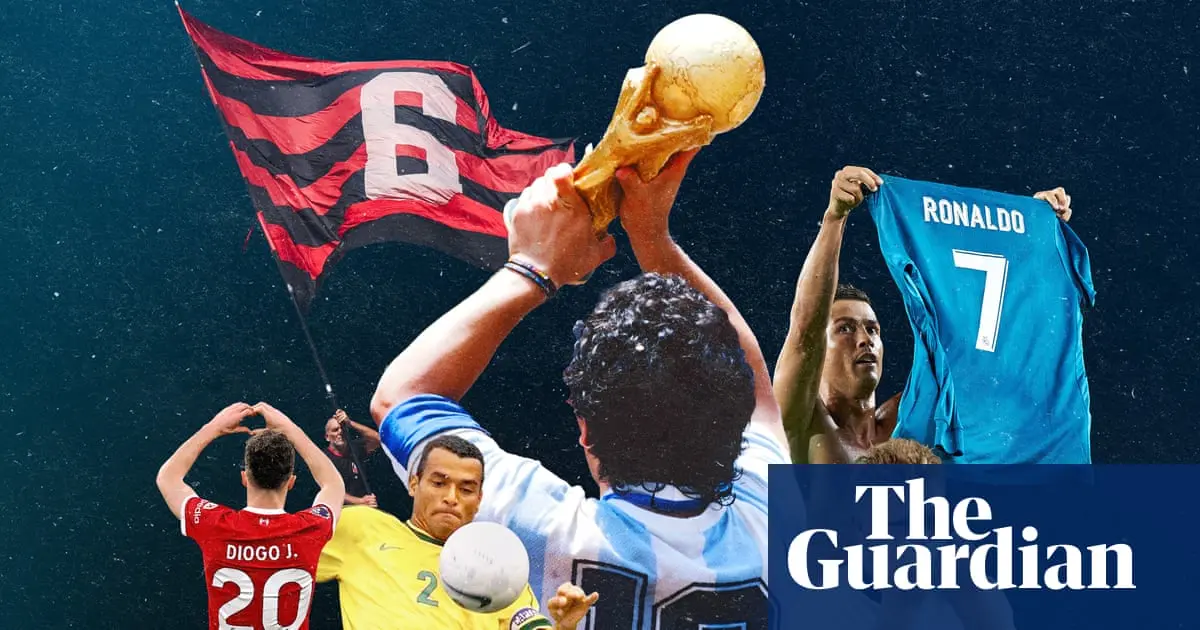
Lev Yashin, the Soviet Union’s legendary goalkeeper, is identified as the definitive No 1 in a comprehensive new ranking of male footballers. The list, which spans squad numbers one through fifty, evaluates players based on longevity, achievements, and the distinct association between the athlete and their shirt number. Yashin, who played for Dinamo Moscow and the USSR in the 1950s and 1960s, remains the only goalkeeper to have won the Ballon d’Or.
Known as the “Black Spider” or “Black Panther” due to his trademark dark kit and flat cap, Yashin’s selection is described as a simple choice. The ranking acknowledges other greats such as Dino Zoff and Peter Schmeichel, but Yashin’s unique status in the position secures his place at the top of the list. His iconic presence in goal during the 1966 World Cup semi-final against West Germany at Goodison Park remains a defining image.
For the No 2 shirt, Brazilian right-back Cafu is named the most legendary wearer, a decision driven by dynamism and flair. Although Djalma Santos and Carlos Alberto wore No 4 during their World Cup victories in 1958 and 1970, Cafu’s career statistics are unmatched. He is the only man to play in three consecutive World Cup finals, winning the trophy in 1994 and 2002.
Cafu’s tenure as a “bullet train on the right” for Brazil, Roma, and Milan included more than 700 club games. His relentless runs up the right flank and leadership as captain during the 2002 World Cup glory cement his legacy. The selection recognises the rich history of Brazilian full-backs, with Cafu standing out for his consistency and global impact.
Paolo Maldini is universally recognised as the definitive No 3, a choice few could dispute. AC Milan has retired his number, stipulating it can only be used again if one of his sons plays for the club. As a left-back or left-sided centre-back, Maldini came as close as anyone to perfecting the art of defending.
The ranking notes the oddity that Maldini did not wear No 3 at Italia 90 or USA 94, yet for most of his career, he was inextricably linked to the number. Seeing him in any other shirt would have been akin to seeing James Bond in a shell suit. His rare moments of chasing opponents, such as Chris Waddle or Karel Poborsky, are described as historic moments.
Javier Zanetti is selected for the No 4 shirt, edging out Pep Guardiola, Sergio Ramos, and other Brazilian right-backs. A “Swiss Army knife” of a footballer, Zanetti demonstrated that right-back and centre-midfield positions spoke the same language. He won 16 trophies in 19 years at Inter, 15 of them as a quietly inspirational captain.
Inter Milan has also retired Zanetti’s number, mirroring the honour bestowed upon Maldini by his Milanese rivals. José Mourinho described it as “an honour to coach him”, while Maldini called Zanetti “my most respected enemy.” Zanetti’s leadership and versatility made him a cornerstone of Inter’s success during his long tenure.
For the No 5 shirt, Franz Beckenbauer is the clear choice, with apologies to Zinedine Zidane, Fabio Cannavaro, and Obdulio Varela. Beckenbauer, the libero and captain of the all-conquering West Germany and Bayern Munich sides of the 1970s, was born to stroll around a football field. His biographer, Uli Hesse, wrote that the number “became synonymous with his unique interpretation of the libero role.”
Bayern Munich retired their No 5 shirt in December 2024, a move that rightly acknowledges Beckenbauer’s unparalleled status. The ranking notes that nobody did the libero role better, and nobody ever will. Beckenbauer’s majestic action for West Germany against the USSR in June 1972 remains a testament to his class and control on the pitch.
The No 6 shirt is associated with iconography rather than modern tactics, which typically designate it for a deep-lying midfielder. In the 20th century, it was indelibly linked to a specific genre of centre-back: captains, leaders, and legends. The list is headed by Bobby Moore, Tony Adams, and Franco Baresi, the “don” of Italian football.
Baresi, a manager on the field for Arrigo Sacchi and Fabio Capello during Milan’s golden age, had his shirt retired by the club in 1997. He died this year, and the ranking suggests that any doubts about his status as the definitive No 6 are dispelled by the pictures from his funeral in August. His leadership and defensive mastery remain unmatched in the history of the position.
The No 7 shirt is a contentious choice, with the ranking acknowledging that it probably should have been given to Garrincha. Garrincha wore No 7 when he single-footedly won the 1962 World Cup for Brazil, a feat that defined his legacy. However, the final selection is based on a trademark association that overrides historical precedence in this specific context.
The relationship between players and numbers is a long-established one, filled with memories and fascinating stories. The ranking considers how long a player wore the number, what they achieved in it, and why they decided to wear it in the first place. In some cases, the association is strengthened by the player’s death, creating a permanent link between the individual and the shirt.
This list is highly subjective and ultimately a bit of fun, but it invites readers to be shocked and furious in equal measure. The selection process involves weighing various factors, from statistical achievements to cultural impact. The goal is to identify the male player most distinctly associated with each squad number from one to fifty.
The ranking highlights the diversity of footballing styles and eras, from the mythical goalkeeping of Yashin to the elegant defending of Maldini. It also recognises the tactical evolution of positions, such as the shift from the traditional centre-back to the modern deep-lying midfielder. Each number carries its own history and significance within the sport.
Readers are encouraged to engage with the list, sharing their own opinions and debates about the selections. The subjective nature of the ranking ensures that it will spark discussion among fans and experts alike. The stories behind the numbers offer a glimpse into the rich tapestry of football history.
Reporting verified from official briefings and primary coverage by www.theguardian.com.










Reader Discussion & Comments (0)
Join the conversation. All comments are moderated in accordance with our editorial standards.