
New Swansea mural celebrates Welsh women and music
A vibrant mural by Zoë Power on Swansea Arena honours Welsh women, language and music, adding colour to the city’s Muriau Mawr trail.
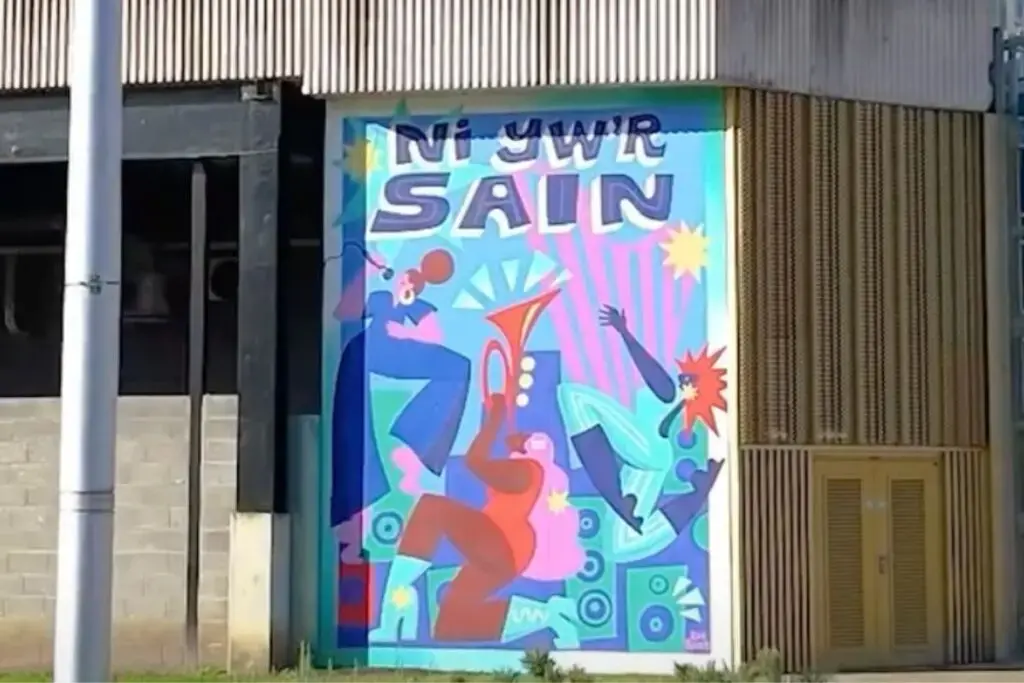
A new mural celebrating Welsh women, music and cultural identity has been unveiled on the side of Swansea Arena.
Titled Ni Yw’r Sain (We Are The Sound), the large‑scale artwork was created by Welsh artist Zoë Power.
The piece stretches along Oystermouth Road, close to the Copr Bay bridge, and is visible to motorists and pedestrians travelling through the city centre.
Power’s design explores the links between music, Welsh language and the role of women in shaping community life.
The concept emerged from a community session organised by MIOE Creative Productions at Swansea Arena.
Local women took part in the discussion, sharing experiences of music, identity and empowerment.
Those conversations informed the mural’s colour palette, figures and symbolic motifs.
Power also drew on her own upbringing in a family of strong Welsh women.
She said the project allowed her to “bring together personal history and collective memory on a public canvas”.
The artwork forms the fourth large‑scale piece on Swansea’s Muriau Mawr street‑art trail.
Earlier murals on the trail have highlighted the city’s industrial heritage, maritime history and contemporary creativity.
By adding a new visual landmark, the mural expands the trail’s narrative to include women’s contributions to Welsh culture.
Funding for the project came from ATG Entertainment, Celf Cymru Arts and Swansea Council.
These bodies collaborated with MIOE Creative Productions, which helped to coordinate the community engagement and logistical planning.
The mural’s prominent placement beside the arena ensures it will be seen by concert‑goers, theatre audiences and sports fans alike.
Visitors to the venue can pause to view the colourful depiction of women singing, playing instruments and embracing Welsh language.
Local residents have praised the addition of public art to an area previously dominated by utilitarian façades.
“It brings colour to the streets and reflects who we are as a community”, one passerby remarked.
City officials have highlighted the work as part of a wider strategy to enrich urban spaces with creative interventions.
Mayor of Swansea’s office noted that such projects “enhance the city’s cultural profile and support local artists”.
Zoë Power, who has exhibited across Wales and the UK, described the mural as a “visual anthem for women’s voices in Wales”.
The artwork incorporates traditional Welsh patterns alongside contemporary graphic elements.
Its bilingual title underscores the importance of the Welsh language in everyday life.
Community participants reported feeling a sense of ownership over the final piece.
One workshop attendee explained that seeing their ideas reflected on a building “makes the city feel more like home”.
Muriau Mawr, the city’s street‑art initiative, aims to commission works that resonate with local stories.
Since its launch, the programme has attracted tourists and boosted footfall in the surrounding neighbourhood.
Local businesses have reported increased interest from visitors drawn to the mural’s vibrant façade.
The project also aligns with national efforts to promote gender equality in the arts.
Arts Wales has highlighted the mural as an example of “women‑led creative practice gaining public visibility”.
With the mural now complete, the city looks to continue expanding its public art portfolio.
Future plans include additional works along the waterfront and in the historic town centre.
For now, Ni Yw’r Sain stands as a bold statement of Welsh women’s enduring influence on music, language and community life.