
M4 eastbound snarls see 35‑minute delays beyond Prince of Wales Bridge
Drivers on the M4 eastbound between junctions 22 and 19 face up to 35‑minute delays as traffic crawls at 10mph, with the cause still unclear.
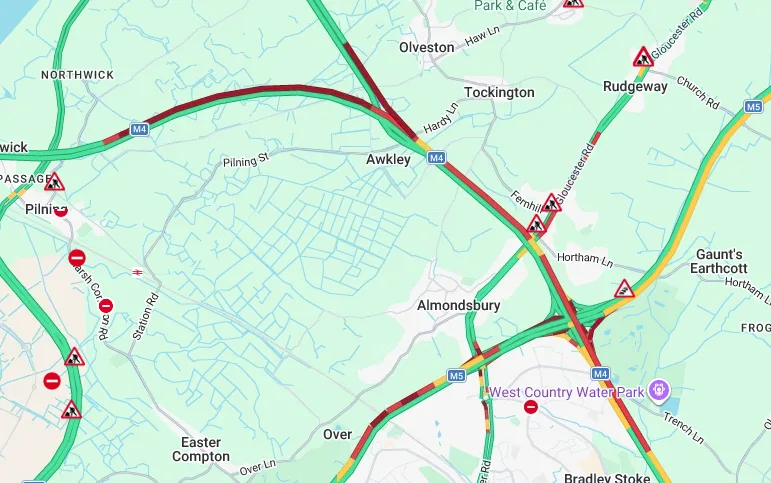
Drivers travelling eastbound on the M4 have been forced to endure delays of more than half an hour on the stretch beyond the Prince of Wales Bridge.
Traffic between junction 22, where the M49 joins, and junction 19, near the M32, is moving at an average speed of just 10 mph.
Journey times that would normally take under ten minutes are now stretching to around 35 minutes, according to live traffic monitors.
The bottleneck has been reported across the region since early morning, with congestion building steadily as the day progressed.
Motorists have described the scene as a “wall of brake lights”, with queues extending for several miles on either side of the bridge.
The Prince of Wales Bridge, the vital crossing over the River Severn, carries a significant proportion of freight and commuter traffic between South Wales and the West of England.
Its strategic importance means any disruption quickly ripples through the wider road network, affecting journeys to Cardiff, Newport and beyond.
Highways England confirmed that crews are on site, but the precise cause of the slowdown has not yet been identified.
Initial assessments suggest a possible incident or vehicle obstruction, yet no official confirmation has been released.
South Wales Police have urged drivers to avoid the area if possible and to seek alternative routes.
Detour advice points motorists towards the A48 and the M5, though these roads are already experiencing heightened volumes.
Local businesses have warned that the gridlock could delay deliveries, particularly for time‑sensitive goods moving through the port of Newport.
Freight operators have reported that lorries are being forced to queue for extended periods, raising concerns about supply‑chain knock‑on effects.
Commuters heading into Cardiff for work have been forced to adjust their travel plans, with many opting for earlier departures or public transport alternatives.
First South Wales services have seen a surge in passenger numbers on the Cardiff‑Newport rail line as drivers seek to bypass the jam.
Transport for Wales has issued a reminder that train capacity may be limited during peak periods, urging passengers to check timetables before travelling.
The congestion has also impacted emergency services, with ambulance crews reporting longer response times on routes that intersect the affected M4 stretch.
Health officials have highlighted the potential risk to patients requiring urgent care, calling for patience and cooperation from the public.
Local councillors have expressed frustration at the lack of information, urging the responsible agencies to provide regular updates.
One councillor noted that “our constituents rely on this corridor for work and essential services, and the current situation is untenable”.
Environmental groups have warned that prolonged idling could increase emissions in the area, adding pressure to resolve the blockage swiftly.
Air quality monitors near the bridge have already recorded a rise in nitrogen dioxide levels, a typical by‑product of traffic congestion.
Meanwhile, motorists using navigation apps have reported mixed messages, with some routes recalculating to avoid the jam while others continue to direct traffic into the bottleneck.
Experts suggest that real‑time data sharing between traffic management centres and navigation providers could help mitigate such incidents in the future.
As the day wears on, the delay appears to be persisting, with no clear indication of when traffic will return to normal speeds.
Travellers are advised to stay informed through official traffic bulletins and to allow extra time for journeys that must cross the Prince of Wales Bridge.
Authorities have pledged to investigate the cause of the congestion and to implement measures to prevent a recurrence.
For now, the M4 eastbound remains a slow‑moving queue, a stark reminder of the fragility of the region’s main transport artery.