
NWS confirms no tornado in San Clemente storm
Severe thunderstorm winds exceeded 58 mph in San Clemente, uprooting trees. NWS meteorologists confirmed straight-line wind damage, ruling out a tornado.
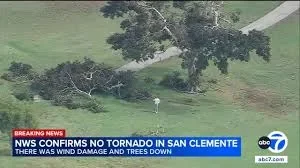
A powerful severe thunderstorm swept through the coastal city of San Clemente in California, causing significant localised damage as high winds tore through residential and public areas. The National Weather Service (NWS) has officially confirmed that no tornado touched down in the region, clarifying the nature of the destructive weather event that struck on Wednesday evening.
Emergency personnel and meteorologists were dispatched to survey the extent of the destruction following the storm’s passage. The agency determined that the severe thunderstorm pushed through the area around 6 p.m. or 7 p.m.
on Wednesday, bringing with it intense atmospheric instability.
Preliminary assessments indicate that wind speeds most likely exceeded 58 miles per hour, a force sufficient to uproot mature trees and scatter debris across the landscape. The NWS noted that the strength of the winds was particularly notable given the resilience of local vegetation, specifically palm trees, which are known to withstand very strong gusts.
Meteorologists on the ground observed that the storm’s strong winds affected only a small, concentrated area, ruling out the rotational characteristics typical of a tornado. The damage pattern was consistent with straight-line winds rather than the chaotic debris field associated with tornadic activity.
Former San Clemente Mayor Tim Brown provided crucial visual evidence by recording video footage while on the municipal golf course as the storm passed. His clip captured the sudden onset of heavy rain and the dramatic uprooting of trees, illustrating the raw power of the weather system.
Brown described the suddenness of the event, stating that the winds and rain came out of nowhere, catching residents and officials by surprise. The footage serves as a key reference point for meteorologists analysing the storm’s trajectory and intensity in the immediate aftermath.
NWS meteorologist Adam Roser provided a detailed technical analysis of the incident, emphasising the directional nature of the wind damage. He explained that the debris was found travelling in one specific direction, a hallmark of straight-line wind events rather than rotational storms.
“Taking a look at weather data, discussing this with my colleagues, it looks like this is straight line wind damage,” Roser stated. He further elaborated that the winds originated from the coast and moved inland, creating a focused corridor of high-velocity air.
The severe weather event resulted in several trees coming down, posing potential hazards to nearby infrastructure and public safety. The NWS personnel conducted a thorough survey to assess the structural impact on the municipal golf course and surrounding neighbourhoods.
The rapid response by weather services helped to quickly dispel initial rumours of a tornado, ensuring that emergency resources were directed appropriately towards storm damage mitigation. The clarity provided by the NWS is essential for community recovery efforts and future weather preparedness.
Straight-line winds are a common feature of severe thunderstorms, often resulting from the outflow boundary of a storm cell. These winds can travel at hurricane-force speeds over a limited area, causing widespread but directional damage.
The distinction between straight-line winds and tornadoes is critical for accurate reporting and public safety messaging. While both phenomena can be destructive, their underlying meteorological mechanisms and damage patterns differ significantly.
Local authorities and residents are now focused on clearing debris and assessing any structural damage to homes and public facilities. The swift confirmation by the NWS that no tornado occurred helps to streamline the recovery process and manage public expectations.
The incident highlights the importance of accurate weather forecasting and rapid communication during severe weather events. Community resilience was tested as residents navigated the aftermath of the high-wind storm.
Meteorologists continue to monitor atmospheric conditions in the region to ensure no further severe weather cells develop. The data collected from this event will contribute to a broader understanding of storm behaviour in coastal California.
The NWS remains committed to providing real-time updates and accurate information to the public, ensuring that communities are well-informed and prepared for future weather challenges.
The snapping of palm trees serves as a tangible indicator of the extreme wind speeds experienced during the storm. These trees are generally robust and require significant force to break, underscoring the severity of the gusts.
Roser noted that the ability of the winds to snap such sturdy vegetation was a key factor in determining the intensity of the event. This observation supports the conclusion that wind speeds exceeded the 58 mph threshold.
Residents are advised to remain vigilant during periods of severe weather, following guidance from local emergency services and the National Weather Service. Understanding the signs of different weather phenomena can help individuals take appropriate safety precautions.
The incident in San Clemente serves as a reminder of the unpredictable nature of severe weather, even in regions not typically associated with tornado activity. Preparedness and awareness are crucial for minimising the impact of such events.
The National Weather Service has concluded its initial investigation into the storm, confirming the absence of a tornado and identifying straight-line winds as the primary cause of damage. The findings provide a clear understanding of the meteorological conditions that led to the incident.
This accurate reporting helps to maintain public trust in weather services and ensures that future responses to severe weather are based on verified scientific data. The collaboration between local officials and meteorologists was instrumental in managing the situation effectively.